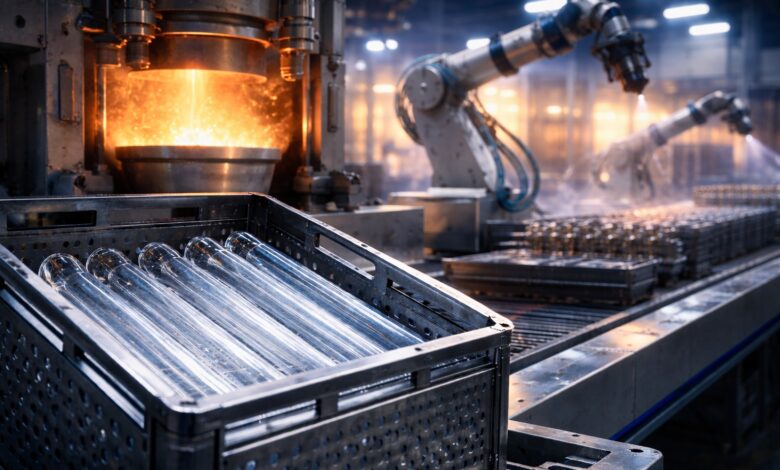
Industrial systems today operate under conditions that would have been considered extreme just a few decades ago. Higher processing temperatures, longer operating cycles, and tighter performance tolerances have become common across manufacturing, energy, and materials industries. Behind these advances lies a less visible factor: the materials that can reliably function under sustained thermal stress.
In many high-temperature industrial settings, structural and containment components must remain stable while exposed to repeated heating and cooling. Materials such as quartz glass tubes used in industrial processes requiring stable high-temperature environments are often selected because their physical behavior remains predictable when conventional materials begin to deform, react, or degrade. Their role is not to drive innovation directly, but to ensure that processes can operate consistently without interruption.


As industries push equipment closer to thermal and mechanical limits, material selection increasingly determines whether a process can scale safely and economically.
Why High-Temperature Environments Create Unique Challenges
Operating at elevated temperatures introduces a combination of stresses that are difficult to manage simultaneously. Heat accelerates chemical reactions, alters mechanical properties, and amplifies small design imperfections. Over time, even minor instabilities can lead to equipment wear, contamination, or loss of process control.
In continuous production environments, these effects compound. A process that appears stable during short test runs may behave very differently after thousands of operating hours. Materials that expand unevenly, react with surrounding substances, or lose surface integrity can introduce variability that is difficult to detect until performance begins to decline.
This is why high-temperature applications require materials that are not only heat-resistant, but also dimensionally and chemically consistent over long periods.
The Role of Containment and Handling Materials
Beyond structural components, high-temperature industries rely heavily on materials that enable safe containment and handling. Melting, sintering, and thermal treatment processes all depend on vessels that can tolerate intense heat without interacting with the materials they hold.
In these contexts, quartz glass crucible applications in high-temperature material processing workflows illustrate how material choice affects process reliability. Crucibles must withstand repeated thermal cycles while maintaining purity and shape, ensuring that the materials being processed are not compromised by contamination or unexpected reactions.
When containment materials fail to meet these requirements, the consequences extend beyond equipment damage. Product quality can suffer, yields may drop, and entire batches can be lost.
Consistency Over Time Matters More Than Peak Performance
A common misconception in industrial design is that materials should be evaluated primarily on their maximum performance limits. In reality, long-term consistency is often more important than peak capability. A material that performs exceptionally well at high temperature for a short duration may be less valuable than one that performs slightly below that threshold but does so reliably over extended use.
Industries that prioritize lifecycle performance tend to experience fewer unplanned shutdowns and lower maintenance costs. Stable materials reduce the need for frequent recalibration, replacement, and manual intervention, allowing processes to remain predictable and efficient.
Materials as Enablers, Not Bottlenecks
High-temperature materials rarely attract attention when systems operate smoothly. Their importance becomes visible only when they fail. Warping, cracking, or chemical interaction can turn a stable process into a costly problem almost overnight.
By selecting materials designed for thermal stability and long-term use, industries transform these components from potential bottlenecks into enablers of reliable operation. This shift supports higher productivity, safer working conditions, and more consistent output.
Conclusion
As industrial processes continue to evolve, high-temperature environments will become more common rather than less. Success in these conditions depends not only on advanced equipment and control systems, but on the materials that form the physical foundation of production.
Materials capable of maintaining stability under sustained heat play a quiet but essential role in modern industry. By understanding and respecting these material constraints, organizations can build processes that are not only more powerful, but also more resilient over time.